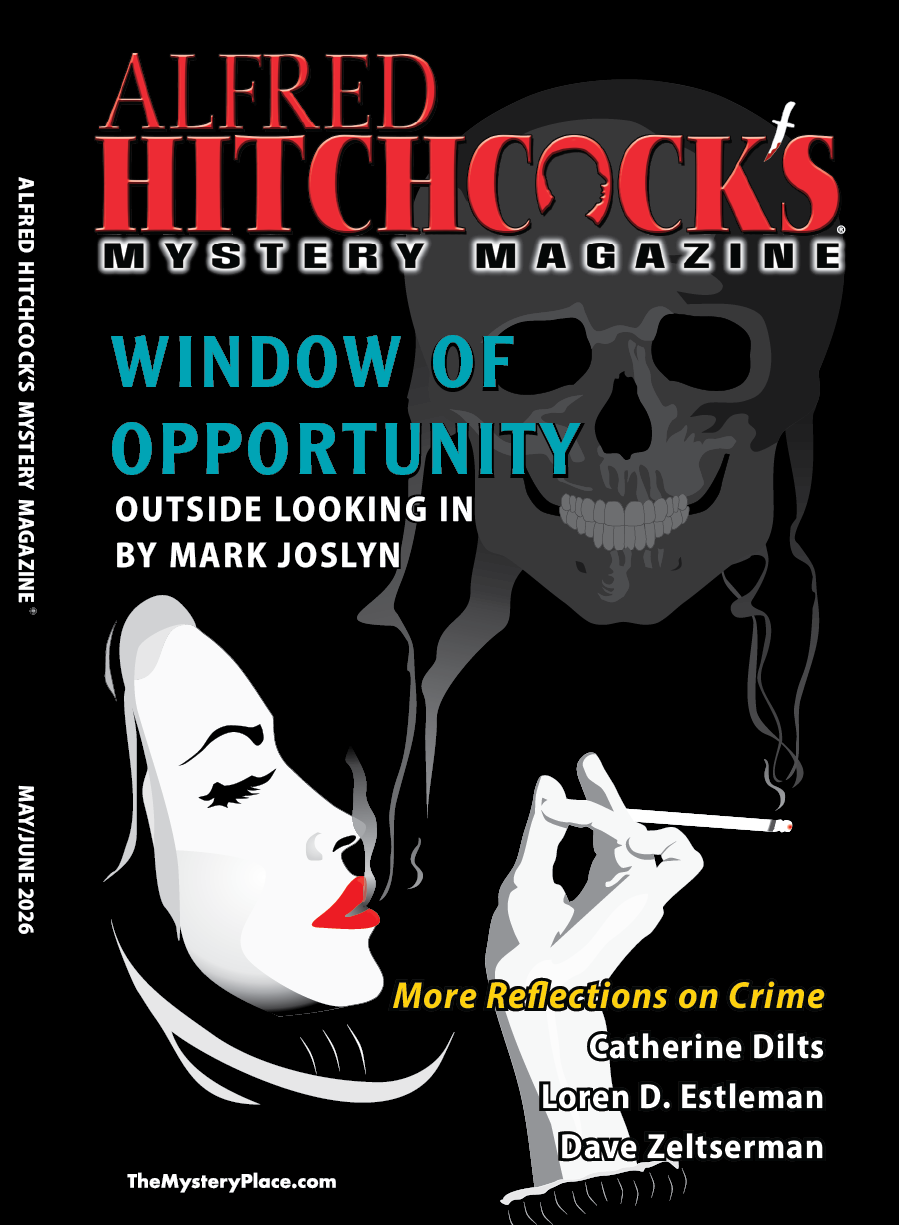
Sunday, July 26, 2026

Noir Canal, by Manu Causse

"Noir Canal," by Manu Causse, in Toulouse Noir, edited by Charles-Henri Lavielle, Akashic Press, 2026.

Akashic Press sent me a free copy of this book. 

Some of the stories in this book seem more interested in giving tours of a neighborhood than exploring a crime.  Not this one, though.  It gives the readers a mystery: not a  whodunit, but a why.

Olie is a trans woman who is a sociology student and volunteers to help prostitutes.  You would think that gives her plenty of reasons to want to avoid the police.So why did she call the police at 4 A.M. to report finding a murdered man beside the canal? And then stay around to answer their questions?  

She has her reasons, which we will eventually learn. Along the way we will also learn a great deal about how prostitution works in France.  Very nice ending, too. 


Sunday, July 19, 2026

The Briar Patch, by Tom Milani

"The Briar Patch," by Tom Milani, in Wish Upon a Crime: Crime Fiction Inspired by Fairy Tales, edited by Michael Bracken, and Stacy Woodson, Level Best Books, 2026.Michael Bracken sent me a copy of this book.  Some themed anthologies are pretty general - stories about movies, say - and some are very specific.  For example, each of these crime stories uses the title of, and refers to the plot of, a fairy tale.In the original tale Brer Rabbit outsmarts the bigger and dangerous Brer Fox by convincing him to "punish" the bunny by tossing him into the briar patch - exactly where he wants to be. So how does that turn into a modern mystery story?Rabbit is the nickname of a worker at Brothers Salvage, an auto junkyard.  The boss thinks he's reliable but not very bright.  So we're ready for our hero to be underestimated, and he is.The junkyard is being used as a transfer point for drugs and one day Mr. Fox comes to pick some up, but Rabbit has done something with them.  Can Rabbit outsmart the violent Mr. Fox? Can a bunny hop?There are a few nice easter eggs in this fun story, such as the name of the bartender.  


Sunday, July 12, 2026

Pitchapalooza, by Robert Parker

 "Pitchapalooza," by Robert Parker, in Black Cat Weekly, #253, 2026. 

The main character  of this tale is Geneva Slitherbee (great name). Notice I didn't call her the heroine, cause heroic, she ain't.  She is a literary agent attending Pitchapalooza where "wannabe writers... for the price of their conference registration and some 50 bucks or so per pitch... get five minutes to convince an agent just to consider looking at their years of writing."

We quickly learn that Geneva is not taking their work seriously but we can hardly blame her considering the quality of the pitches we hear about.  "Think Dirty Harry meets Night of the Living Dead meets Bridget Jones's Diary," one wannabe urges.  We'd rather not. 

Is there a crime here, other than collecting those fees for allegedly listening to pitches?  There is.  Is this story funny? Oh, yes.

I admit the ending isn't as strong as I hoped, but a good time will be had on the way. 


Sunday, July 5, 2026

Three Billy Goats Gruff, by Michael Bracken

 "Three Billy Goats Gruff," by Michael Bracken, in Wish Upon a Crime: Crime Fiction Inspired by Fairy Tales, edited by Michael Bracken, and Stacy Woodson, Level Best Books, 2026. 

Michael Bracken, friend and fellow SleuthSayer, as well as co-editor of this book, sent me a free copy. And what do you know? His story is the best I have read so far in the book. It also marks his thirteenth appearance in this blog.  

One of the big trends in popular fiction these days is retellings of mythology.  Someone should do an anthology of that, don't you think?  While we wait for that one we have this volume based on fairy tales.  Some are grim (Grimm?). This one, not so much.

Three brothers, Buck, Billy, and Kid Gruff, run a disreputable marijuana dispensary.  When a virus starts destroying their crops they hope to negotiate a deal with their long-time rivals, the Troll family.  But only the patriarch of that family can make such arrangements and to reach him the Gruffs have to cross a Troll (or toll) bridge.  Lot of puns here, naturally...


Sunday, June 28, 2026

One For Yes, Two For No, by Will Ferguson


 "One For Yes, Two For No," by Will Ferguson, in Alfred Hitchcock's Mystery Magazine, July/August 2026.

Let's  talk a bit about  Alfred Hitchcock's Mystery Magazine, where this story appeared. It was founded in 1956 and was inspired less by the Master's movies than by his popular TV show Alfred Hitchcock Presents. Like that show it has always favored humor, suspense, and twist endings.

There is a famous episode of that show called "Breakdown" in which Joseph Cotton plays the paralyzed victim of a car accident, trying desperately to convince the hospital staff that he is conscious. 

And that's close to what happens in this story, but Ferguson adds several layers of complication.  Mike, the man apparently in a persistent vegetative state, is a cop and he was shot while trying to help a waitress who witnessed a murder.  He can feel nothing except the tube in his throat. All he can do is listen and think.  What he hears gives him plenty allowed to think about, and he has crucial decisions to make.  

An excellent story of suspense. 

Sunday, June 21, 2026

The Mystery of Sea and Sky, by Charles John Harper


 "The Mystery of Sea and Sky," by Charles John Harper, in Ellery Queen's Mystery Magazine, May/June 2026

This is the second story by this author to be reviewed here, if C.J. Harper is who I think he is. This story is a lot cuddlier than that other one.

Although our protagonist would hate be called cuddly. Skyler's a fifteen-year-old kid with all the grumpiness  and mood swings you'd expect.  Worse, his mother has flown him from their home in beautiful California to Minneapolis to meet "my thousand-year-old British-- or was it Irish? -- grandfather. A boomer so cringe?"

Seamus, the boomer in question, is a private eye and he's especially glad to meet his grandson that day because his assignment is to find a fifteen-year-old  girl and he figures Skyler has a better chance of figuring out where the girl would go.

And Skyler, with alternating moods of reluctance and enthusiasm, does figure out the vital clue.  It's a fun story. 

Monday, June 15, 2026

A Regular Guy, by Chris L. Robinson

"A Regular Guy," by Chris L. Robinson, in Ellery Queen's Mystery Magazine, May/June 2026

 .

My whole career has consisted of a little street-fighting, then security, then debt collection, and for a while now,this thing, which is pretty much the top of the heap for a guy with a resume like mine.

Nice writing, that.

As you can probably guess our protagonist is a hit man, doing jobs for a local mob.  But his work often takes him out of town, and this story finds him in New Orleans.  So there is a killing to take care of but what most interests "Mr. Smith," and  me, is a brand-new type of crime he discovers.   I won't go into more detail than that.  It's a fun story.

Sunday, June 7, 2026

The Orient Club, by Robin Hazard Ray


"The Orient Club," by Robin Hazard Ray, in Alfred Hitchcock's Mystery Magazine, May/June 2026.

You are probably familiar with the phrase TMI, meaning Too Much Information.  Imagine a stranger telling you about their kidney operation, or love life. Or both.

In the world of fiction we usually call TMI an expository dump. Here is an undigested heap of information you, the reader, needs to know.

But what about Too Little Information? Sometimes the writer deliberately doesn't explain things, forcing the reader to make the last connections for themselves.  This is great if you do make the connections, annoying if you don't. 

In this story Ray does a little of both and makes it work.

Carol is an older woman, living in Boston, and the bane of her neighborhood is the Orient Club, a forlorn building that has stood untouched since it partially burned down two years earlier.  One day she sees a young man - just turned 18 - named Brandon who thinks he is now the owner of the property.  Brandon was a foster kid with a complicated history.

Carol tells him about the equally complicated history of the Orient Club which, over the decades, has had many owners and many different businesses   And here we have our expository dump, which Ray makes fascinating.

Brendan moves into Carol's house as they try to figure out the mysteries of the Orient Club, especially the fact that someone is paying the city taxes on the property to keep it from being torn down.  I don't mean to suggest that the two are comfortable partners.  The relationship between them is one of the stories best elements.

One night Brandon did not come home from the restaurant. When he finally opened the door late the next day, Carol was waiting. She called him an ingrate and graphically described the kind of sexually transmitted diseases he was likely to pick up. He listened impassively until she was done, then he took the house keys out of his jeans pocket and jingled them.

"Where did [your son] leave his? The mantlepiece? I'm eighteen and fuck off."

But this unlikely team pursues the mystery and -- we don't immediately understand how Carol figures out the answer.  The reader has to work that out for themselves.  And you will have fun doing it.

Sunday, May 31, 2026

Strangers on a Train on a Train, by Paul Ryan O'Connor


"Strangers on a Train on a Train," by Paul Ryan O'Connor, in Alfred Hitchcock's Mystery Magazine, May/June 2026. 

This is the second story by O'Connor to grace this page.  The main character of the first story is a minor player in this one.  Great title, by the way.

Cass is a college student and she is watching guess-which-movie on her phone  on a subway train when a stranger comes up and starts talking to her about it.  He's interested in making a deal with her, similar to the one in the flick: an exchange of crimes.


"What if I don't want to kill anyone?" Cass said.

"You mean if you don't want to kill anyone YET," the man said.

The man's name is Pollock and he is a cop.  He knows a lot about Cass, which is a puzzle because there is a lot to know.  She is not your average college student. This means she is in more danger than you might expect, but it might mean more danger for someone else.

A nicely suspenseful story with many twists and turns.

Monday, May 25, 2026

Pandora's Bounty, by Gilbert M. Stack


"Pandora's Bounty," by Gilbert M. Stack, in Alfred Hitchcock's Mystery Magazine, May/June 2026.

I was surprised that this is only the second time one of Stack's stories made my best-of list.  I am very fond of the tales in this series.

He writes western mysteries about an unusual trio of adventurers. Corey "Rock Quarry" Callaghan is a bare-knuckle boxer making a precarious life fighting for money through the small towns of the west.  Patrick Sullivan is his trainer.  Pandora Parson is a professional gambler, and the brains of the group.

Patrick is especially not the brains.  In fact, in any situation he is pretty much guaranteed to make things worse.  There was one point in this story when he said something so ill-advised that I startled my wife by gasping out loud.

So, what is the situation the friends find themselves in?  A bounty has been put out for Corey because he beat up two miners and stole their gold.  Except he didn't do that, of course. Someone is imitating our hero, boxing under his name, and dirtying it in the process.

Pandora, naturally, comes up with an elaborate scheme to draw the impostor to them and then expose him.  A clever and satisfactory story.

Monday, May 18, 2026

It's Complicated, by Nick Guthrie

 "It's Complicated," by Nick Guthrie, in Alfred Hitchcock's Mystery Magazine, March/April 2026.

"There's a million and one ways to lose a body out here, if that's what you want to do," Reuben called after me, before laughing again. He spoke like a man who knew all the best places to hide a body on this fifteen hundred-acre  estate and hadn't quite used them all up yet.

 Reuben, gamekeeper on said estate is one of several people who might be a help our narrator, Suzie Lee. Or might be her worst enemy.  Because she can't trust anyone.

Suzie is a cop and she has been hiding in this rural area of England for four months with Kurt, her ex-lover.  He is another cop and  has been investigating corruption in the highest levels of the police, for which he was rewarded with a bullet.  

Now, after four months of seeming safety they have found a dead body in front of their cabin.  Is it possibly a coincidence?  Sure, but we all know it ain't.  Somebody has found them and somebody wants them dead.  

What does Suzie want, exactly? Well, read the title. 


Sunday, May 10, 2026

Intervention, by Terry Black


"Intervention," by Terry Black, in Ellery Queen's Mystery Magazine, March/April 2026. 

 Very short stories can be wonderful, but, boy, they are hard to review. How much can you say without giving away too much? This tale is very good but it's under 2,000 words, so forgive me if I keep this brief.

Our hero -- well, let him speak for himself.

[T]here's no girlfriend, no guy friends, no social group, no family -- I'm one of a dozen kids in a foster home where no one cares. I get bullied in school and sit alone at lunch and never get invited anywhere, b y anyone.  Zero social life, zero reason to keep on living.

So now he is standing on the roof of a six-store building, girding himself to take that one last step off into the void. Then he sees something, something  which doesn't change his mind but convinces him to postpone the final act for a moment.  

What he sees I can't tell you.  And what happens next, well, that is a clever and satisfying resolution. 

Saturday, May 2, 2026

Shooting for Harvard, by Jeff Soloway


"Shooting for Harvard," by Jeff Soloway, in Ellery Queen's Mystery Magazine, March/April 2026.

This is Soloway's second appearance in this column.  

It is not unusual for private eye stories to contain social commentary, going back at least to Dashiell Hammett's Red Harvest, with its examination of a corrupt mining town.

This is a story about people who have moved to Iowa.  The narrator, nameless as far as I can tell, was a cop but after he got 20 years he retired and followed his ex-wife to her home state to be close to his teenage daughter, Sam.  

He is hired by the Crovens (a great name), a family who moved to Iowa for a different reason: they want their son Stanley to get into Harvard and since that university wants students from every state, Iowa is a better bet than more populated states with more competitive high schools.

Unfortunately someone shot at Stanley and, perhaps accidentally, injured his hand.  The Crovens suspect Billy Haidt, whose family moved to the same Iowa town for the same reason.  These rival families are not charming people.  Here is Billy's mother meeting our hero:

"You innocent. You child. You cop. The game, my friend, is geographic diversity.  Make me some coffee."

The search for truth leads in surprising directions and ends with the best last sentence I've read in quite a while.


Sunday, April 26, 2026

Lest We Forget, by Marilyn Todd


"Lest We Forget," by Marilyn Todd, in Ellery Queen's Mystery Magazine, March/April 2026.

This is Marilyn Todd's third appearance in this column. 

 Repeating myself: Stories I like best tend to have at least one of four characteristics: great characters, twist ending, heightened language, or great premise.  Todd has come up with a great premise.

We are all familiar with that question: Do you remember where you were when (some event, usually tragic) happened?  And of course, we do.

This story is told entirely in connection to that kind of day.  It begins on 9/11/2001 when Amber, age 12, comes home after hearing the horrible news about the terrorist attack only to find her mother murdered in the kitchen.  It appears to be a botched hostage situation because bank video shows her father emptying their accounts to try to pay a ransom.  His car is eventually found, torched, but he never is.

We see Amber growing up, a traumatized  orphan, in scenes linked to Princess Margaret's death, the Columbia disaster, and so on. We're rooting for her to find stability and happiness, against high odds...

I suspected how this excellent story would end (hey, I read a lot of shorts) but that didn't keep me from enjoying it thoroughly. 

Sunday, April 19, 2026

The Texas Chain-Store Manager, by Josh Pachter

"The Texas Chain-Store Manager," by Josh Pachter, in Crimeucopia: A Coterie of Dicks, edited by John Connor, Murderous Ink Press, 2026.


 This is the second story to get reviewed here by my friend  Josh Pachter, not counting the many he has edited in various anthologies. 

Let's start with the title: Bravo.  Don't you wish you had thought of it? 

Helmut Erhard is a semi-retired private eye in a small Texas town, and he has appeared in several of Pachter's previous stories.  In this one he is hired by the manager of a large grocery store. It has just opened and they are alr4eady having trouble with that dreaded retail problem, shrinkage, alias theft.  In this case someone is sticking labels from inexpensive products on costly items, paying the lower price and then returning it for the full price.

Erhard has three days to work in the store fourteen hours a day and figure out what's going on.  This is one of those stories where you see what our hero sees and should be able to figure out what he does (theoretically) , but the trick is how he gathers his evidence. Whether you guess what he's up to or not you will have fun  on the ride.  

Sunday, April 12, 2026

Skeleton Crew, by V.G. Burke


"Skeleton Crew," by V.G. Burke, in Ellery Queen's Mystery Magazine, January/February 2026.

First stories seldom make this list but Burke's did.  

Our protagonist is a guy named Road, a veteran who saw too much and isn't sure he can live with it.  Or that he wants to.  A fellow vet named Sophie tries to keep him from taking a permanent way out, and Road owes her something.  

In Savannah, Georgia he meets a cop, another veteran, who tells Road that what he needs to keep him going  is a mission.  He finds one in a bar: HAVE YOU SEEN DAVID GRANT? A popular habitue of the joint, a genuine nice guy, has vanished.  And Road may still have the skills to track him.  

The story gets pretty brutal.    If it wasn't in EQMM's Department of First Stories it could have worked in their Black Mask Department.

I wish the story had been more tightly edited.  For example, there were a few spots where I couldn't tell who was speaking.  But it's a very enjoyable tale.   


Monday, April 6, 2026

Half-Empty City, by Jodie Snyder


 "Half-Empty City," by Jodie Snyder, in More Trouble in Tucson, Eva Eldridge, 3Sides2, 2026.

It's nice when we can occasionally escape from murder plots and heist capers.

The narrator of this story, nameless I think, is a survivor of domestic violence, now living in her car.  But that's not an option in Tucson in the summer.  She breaks into a home in a  wealthy neighborhood where almost all the residents have vanished to cooler climes.

So she is a criminal, but one with ethics.  She does not damage the house and steals nothing but food and, technically, electricity. The home gives her the breathing space to find a job and things seem to be looking up but two people are taking an unfortunate amount of interest in her.

One is Hank, the sweet elderly neighbor who assumes she belongs in the house.  The other is a co-worker named Tyler who she recognizes as the same kind of bully she ran away. A guy who won't take no for an answer.

Can she solve these problems?  You will have fun finding out. 

Sunday, March 29, 2026

Solstice Sigil, by Laframboise, Michèle.


 "Solstice Sigil," by Michèle. Laframboise,  in Alfred Hitchcock's Mystery Magazine, January/February 2026. 

A lot of good stories in this issue, I must say.  Copy-editing, not so much.

I have read a lot of mysteries set in ancient Rome.  Most of them feature protagonists who have a properly cynical and noirish sentiment about the eternal city but have no doubt that Rome is and deserves to be the ruler of the world.  The best thing about this story is it's refreshing counterpoint to that view.

Our protagonist is a Nubian slave and former gladiator but before that he fought for the army of Carthage. To say he has no love of this city is an understatement.  "Latin was a strange dialect, with the words changing clothes..." he notes.  "Another stupid Roman custom," he grumbles later, and you will agree with him.   

It is Saturnalia, the holiday in which slaves are allowed great liberties.  Our hero (if his name is mentioned, I didn't catch it) has been drinking and gambling when he stumbles over a corpse.  When an army officer sees him near the body he figures he is doomed, but Publius is not a person who jumps to easy conclusions.

Realizing that failure to solve the murder will result in Publius's death (yet another stupid Roman custom) the slave reluctantly decides to help his former enemy out.  The result is a search through Subura, one of the city's nastiest slums.  

Very entertaining.

Saturday, March 21, 2026

The Tattle-Tale Heart, by John Leonard Pielmeier


"The Tattle-Tale Heart," by John Leonard Pielmeier, in Alfred Hitchcock's Mystery Magazine, January/February 2026. 

Hoo-boy. Sometimes the challenge of reviewing a short story is figuring out what you can say without spoilers. Pardon me if I get vague for readers' protection.

It is 1960 and Eleanor Morse, a widow, has just taken a Caribbean cruise at the recommendation of her friend Harry.  Now back in Altoona she opens her suitcase and finds a horrifying surprise. 

 Which leaves her - and us - with a lot of questions.  Who put it there? How, why, and when?  And, come to think of it, why is Eleanor so reluctant to tell the police about her friend Harry?

The answers are surprising and, in some cases, audacious. And that's all I will say about the plot.

But after I finished the story I found myself trying to reverse engineer the plot. Specifically why did this story need to be a historical? What tied the plot to the past?  

I thought of a few details that probably fit 1960 better than 2026, like the scientific element of the investigation, and Eleanor's determined personality does stand out more in those pre-liberation days. But then I remembered that we are told about an incident in her childhood and, oh yes, that works best with the time period.

I'll shut up now.  Go read the story. It's a good one.

Sunday, March 15, 2026

Glass Beach, by Michael Bracken


"Glass Beach," by Michael Bracken, in Alfred Hitchcock's Mystery Magazine, January/February 2026.

This is the twelfth appearance in this space by my friend and fellow SleuthSayer.  

One of my favorite mystery stories is "Witch's Money," by John Collier.  In spite of the title it does not involve the supernatural, but tells how a small European village is turned inside out by the arrival of a (relatively) wealthy American. Bracken's story reminds me of Collier's.

The story takes place near Fort Bragg, California in the early 1970s.  The witch's money in this case is a strongbox full of cash, the loot from the robbery of a lumber company payroll a decade earlier. It is discovered in a dump by Patrick, our teenage narrator, and his fairly hostile stepfather Cush.

They hope to keep the find secret but, inevitably, the ripples start to spread, involving first Patrick's best friend, whose mother works at a bank and knows how difficult will be to  make the money safe to spend.  As complications arise and more people get involved our heroes discover just how difficult easy money can be.  

Terrific story.