Showing posts with label AHMM. Show all posts

Sunday, October 25, 2026

Louie the Mailman, by Jim Fusilli


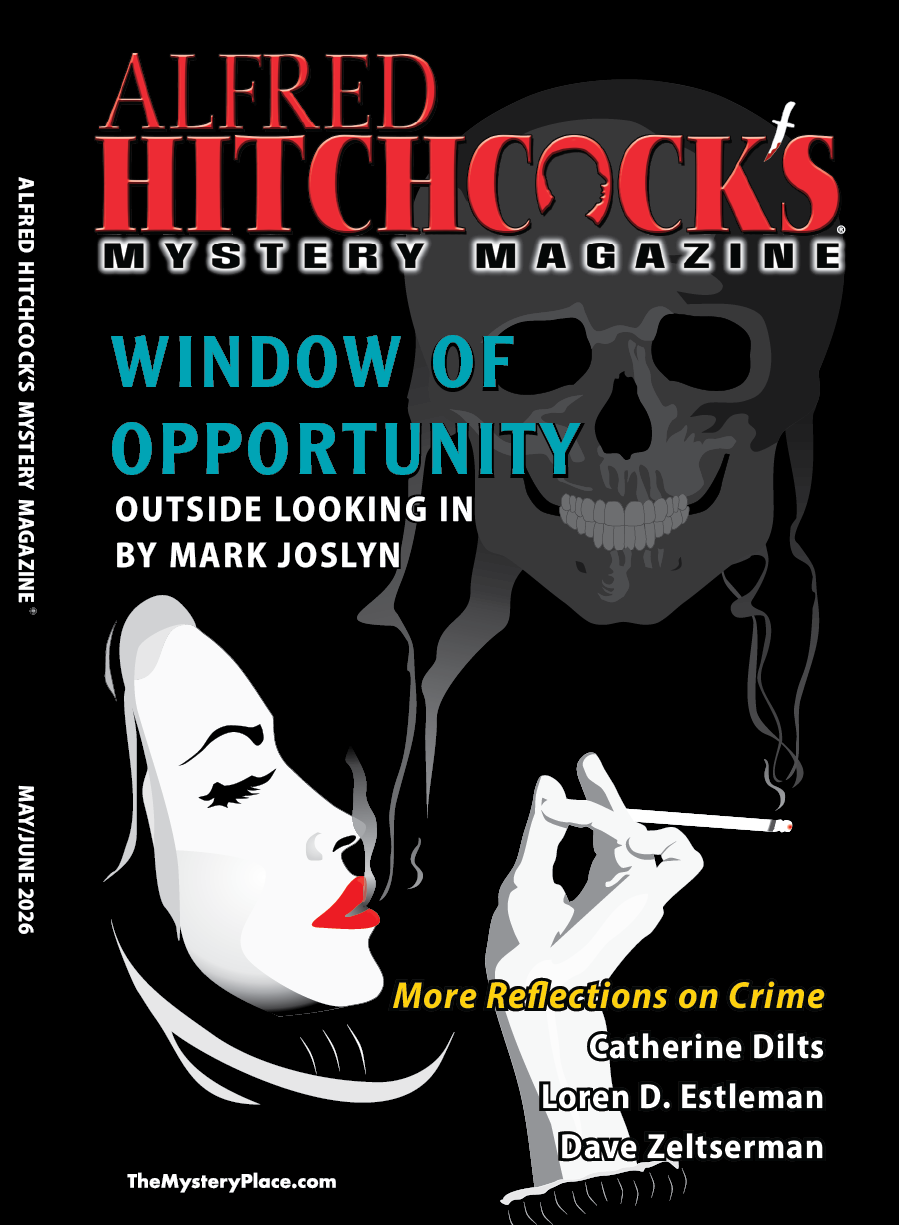
"Louie the Mailman," by Jim Fusilli, in Alfred Hitchcock's Mystery Magazine, November/December 2026.

This marks Fusilli's third appearance in my blog.

It took me a while to determine that this story was set in the current day because it has an old-fashioned feel to it.  This is a story about mobsters and when you hear "Louie the Mailman" you may think it is the nickname of some Mafiosi.  What exactly does the mailman "deliver?" Money? Dope? Revenge? Corpses?

None of the above. Louie Fava really is the postla delivery guy in Little Italy.  He has been in love, since childhood, with Josie and the good news is her husband has just died.  The bad news is that her husband was a Mafia chieftain whose brother now runs things and has no desire to let his sister-in-law get involved with a peasant like Louie.

Ah, but Louie has high hopes and big plans.  I had no idea whether they were going to work out or not. Will David beat Goliath this time? You will have a good time finding out.   

Sunday, September 20, 2026

The Walkout, by Kevin Egan


 "The Walkout," by Kevin Egan, in Alfred Hitchcock's Mystery Magazine, September/October 2026.

Last year I mentioned being surprised that I was reviewing a Kevin Egan story for the first time, since I had enjoyed many of his tales.  That's just how things go sometimes. Now I have to be surprised that this is the first time I reviewed one of his stories about Foxx, troubleshooter for the New York City judicial system.  When a judge goes hinky or a clerk disappears, Foxx is the guy who tries to make the problem disappear, quietly if possible.

But before we get into that let's get a little bit meta.  By definition a mystery story has a crime in it.  But what is a crime? An action which might be legal in one time and place might be forbidden in a different one.  And sometimes something that sure as hell seems like it should be a crime is perfectly legit.

I was thinking about this because I just finished reading The Zorg, by Siddharth Kara, a nonfiction book about one horrifying event that was part of the long chain that led to the elimination of slavery in the British empire. Things turned on one question: when, if ever, is it murder to throw enslaved people overboard to drown?

Which is not the subject of this story, but certainly it is reasonable to ask which parts of Egan's tale are criminal.

Foxx's problem this time is his boss, Major Edward Kearney, the senior officer in the main courthouse, and I do mean senior.  He is in his eighties and people have been pushing him to retire for decades, but he refuses to leave his office - in either sense of the word.

Complicating things is that the major has no valid birth certificate, making it hard to get his pension.  This leads to Foxx being sent to Ireland and the tiny village where Kearney was born. 

People familiar with a certain aspect of Irish history may guess part of what's coming (and I have never before read a short story on this subject). But I absolutely did not see where this fascinating tale was going to end.


Tuesday, September 15, 2026

The Ordnance Special, by James D. Crabtree


"The Ordnance Special," by James D. Crabtree, in Alfred Hitchcock's Mystery Magazine, September/October 2026.

There are war crimes and then there are crimes that take place during wars. I have read a lot of short stories set involving soldiers during wars (and many more about home fronts or veterans).  As near as I can tell the only soldier stories that have made this list are one from World War I, two from World War II, and one from Viet Nam.  Oh, and if you consider the Bleeding Kansas era as a war, we can add one more.

And today we add a story from the Civil War.   

James Merrick is a major in the provost corps of the Confederate Army, meaning he is a military policeman.  In this case he has to solve a murder that took place in a town many miles away.

Oh, and he has exactly a half hour to find the killer. So, no pressure.

The killer is one of the officers arriving on the Ordnance Special, a train stuffed to the gills with weapons for the front. It cannot be long delayed for something as insignificant as the murder of one civilian, not when there are thousands of soldiers to be killed.

A nice reflection on death during war time, with a satisfactory solution. 

I'm going to do something I seldom do.  I want to point out the next story in the magazine: "Look Back With Kindly Eyes," by Dan Crawford. It's not a crime story so I won't review it here, but anyone who can make a a fantasy story at flash length both funny and thought-provoking deserves a mention.


Monday, September 7, 2026

No Property in a Witness, by Mat Coward

 "No Property in a Witness," by Mat Coward, in Alfred Hitchcock's Mystery Magazine, September/October 2026.

This is the eleventh story by Coward to make it to this column.

There really ought to be some way, Robert thought, in which a criminal client could communicate guilt or innocence to their solicitor or barrister... Perhaps it would help if there were some sort of secret handshake? One squeeze for guilty, two for "No seriously, this time I mean it, genuinely not guilty."

As you may have guessed Robert is a barrister facing a shocking problem: his client, a long-time bank robber, apparently didn't commit the one he on trial for.  This throws Robert's entire planned defense into a tizzy.

Coward is a very witty writer, as this one demonstrates.

Sunday, August 30, 2026

Treat or Trick, by Mark Thielman


"Treat or Trick," by Mark Thielman, in Alfred Hitchcock Mystery Magazine, Sept/Oct 2026.

 This is the twelfth appearance in this column by my fellow SleuthSayer. 

Ollie is at a job interview:

"You're here because Grinder recommended you. How do you know The Grind?"
"From around."
"He says you met at juvie.  That right?"
"My records are sealed so that I might move forward in life without the stigma," Ollie recited.
"You want the job, or don't you?"
"We met at juvie." 

 In that bit of chatter we learn a lot about the situation and also the personality of the protagonist. That personality will be a major point of the story since we don't see in his head and we want to figure out how he is reacting to  what's going on.

What's going on is a suspiciously easy job with a cooperative boss.  ROOK is a nonprofit that tries to improve the lives of young people.  And all Ollie needs to do this late October, is give out candy  to all the kids who come to the door.  What could be simpler? 

Do you smell something fishy?  Ollie certainly does.  And we read along, wondering what he plans to do about it.  There are nice clues along the way.  A witty, twisty tale. 


Sunday, June 28, 2026

One For Yes, Two For No, by Will Ferguson


 "One For Yes, Two For No," by Will Ferguson, in Alfred Hitchcock's Mystery Magazine, July/August 2026.

Let's  talk a bit about  Alfred Hitchcock's Mystery Magazine, where this story appeared. It was founded in 1956 and was inspired less by the Master's movies than by his popular TV show Alfred Hitchcock Presents. Like that show it has always favored humor, suspense, and twist endings.

There is a famous episode of that show called "Breakdown" in which Joseph Cotton plays the paralyzed victim of a car accident, trying desperately to convince the hospital staff that he is conscious. 

And that's close to what happens in this story, but Ferguson adds several layers of complication.  Mike, the man apparently in a persistent vegetative state, is a cop and he was shot while trying to help a waitress who witnessed a murder.  He can feel nothing except the tube in his throat. All he can do is listen and think.  What he hears gives him plenty allowed to think about, and he has crucial decisions to make.  

An excellent story of suspense. 

Sunday, June 7, 2026

The Orient Club, by Robin Hazard Ray


"The Orient Club," by Robin Hazard Ray, in Alfred Hitchcock's Mystery Magazine, May/June 2026.

You are probably familiar with the phrase TMI, meaning Too Much Information.  Imagine a stranger telling you about their kidney operation, or love life. Or both.

In the world of fiction we usually call TMI an expository dump. Here is an undigested heap of information you, the reader, needs to know.

But what about Too Little Information? Sometimes the writer deliberately doesn't explain things, forcing the reader to make the last connections for themselves.  This is great if you do make the connections, annoying if you don't. 

In this story Ray does a little of both and makes it work.

Carol is an older woman, living in Boston, and the bane of her neighborhood is the Orient Club, a forlorn building that has stood untouched since it partially burned down two years earlier.  One day she sees a young man - just turned 18 - named Brandon who thinks he is now the owner of the property.  Brandon was a foster kid with a complicated history.

Carol tells him about the equally complicated history of the Orient Club which, over the decades, has had many owners and many different businesses   And here we have our expository dump, which Ray makes fascinating.

Brendan moves into Carol's house as they try to figure out the mysteries of the Orient Club, especially the fact that someone is paying the city taxes on the property to keep it from being torn down.  I don't mean to suggest that the two are comfortable partners.  The relationship between them is one of the stories best elements.

One night Brandon did not come home from the restaurant. When he finally opened the door late the next day, Carol was waiting. She called him an ingrate and graphically described the kind of sexually transmitted diseases he was likely to pick up. He listened impassively until she was done, then he took the house keys out of his jeans pocket and jingled them.

"Where did [your son] leave his? The mantlepiece? I'm eighteen and fuck off."

But this unlikely team pursues the mystery and -- we don't immediately understand how Carol figures out the answer.  The reader has to work that out for themselves.  And you will have fun doing it.

Sunday, May 31, 2026

Strangers on a Train on a Train, by Paul Ryan O'Connor


"Strangers on a Train on a Train," by Paul Ryan O'Connor, in Alfred Hitchcock's Mystery Magazine, May/June 2026. 

This is the second story by O'Connor to grace this page.  The main character of the first story is a minor player in this one.  Great title, by the way.

Cass is a college student and she is watching guess-which-movie on her phone  on a subway train when a stranger comes up and starts talking to her about it.  He's interested in making a deal with her, similar to the one in the flick: an exchange of crimes.


"What if I don't want to kill anyone?" Cass said.

"You mean if you don't want to kill anyone YET," the man said.

The man's name is Pollock and he is a cop.  He knows a lot about Cass, which is a puzzle because there is a lot to know.  She is not your average college student. This means she is in more danger than you might expect, but it might mean more danger for someone else.

A nicely suspenseful story with many twists and turns.

Monday, May 25, 2026

Pandora's Bounty, by Gilbert M. Stack


"Pandora's Bounty," by Gilbert M. Stack, in Alfred Hitchcock's Mystery Magazine, May/June 2026.

I was surprised that this is only the second time one of Stack's stories made my best-of list.  I am very fond of the tales in this series.

He writes western mysteries about an unusual trio of adventurers. Corey "Rock Quarry" Callaghan is a bare-knuckle boxer making a precarious life fighting for money through the small towns of the west.  Patrick Sullivan is his trainer.  Pandora Parson is a professional gambler, and the brains of the group.

Patrick is especially not the brains.  In fact, in any situation he is pretty much guaranteed to make things worse.  There was one point in this story when he said something so ill-advised that I startled my wife by gasping out loud.

So, what is the situation the friends find themselves in?  A bounty has been put out for Corey because he beat up two miners and stole their gold.  Except he didn't do that, of course. Someone is imitating our hero, boxing under his name, and dirtying it in the process.

Pandora, naturally, comes up with an elaborate scheme to draw the impostor to them and then expose him.  A clever and satisfactory story.

Monday, May 18, 2026

It's Complicated, by Nick Guthrie

 "It's Complicated," by Nick Guthrie, in Alfred Hitchcock's Mystery Magazine, March/April 2026.

"There's a million and one ways to lose a body out here, if that's what you want to do," Reuben called after me, before laughing again. He spoke like a man who knew all the best places to hide a body on this fifteen hundred-acre  estate and hadn't quite used them all up yet.

 Reuben, gamekeeper on said estate is one of several people who might be a help our narrator, Suzie Lee. Or might be her worst enemy.  Because she can't trust anyone.

Suzie is a cop and she has been hiding in this rural area of England for four months with Kurt, her ex-lover.  He is another cop and  has been investigating corruption in the highest levels of the police, for which he was rewarded with a bullet.  

Now, after four months of seeming safety they have found a dead body in front of their cabin.  Is it possibly a coincidence?  Sure, but we all know it ain't.  Somebody has found them and somebody wants them dead.  

What does Suzie want, exactly? Well, read the title. 


Sunday, March 29, 2026

Solstice Sigil, by Laframboise, Michèle.


 "Solstice Sigil," by Michèle. Laframboise,  in Alfred Hitchcock's Mystery Magazine, January/February 2026. 

A lot of good stories in this issue, I must say.  Copy-editing, not so much.

I have read a lot of mysteries set in ancient Rome.  Most of them feature protagonists who have a properly cynical and noirish sentiment about the eternal city but have no doubt that Rome is and deserves to be the ruler of the world.  The best thing about this story is it's refreshing counterpoint to that view.

Our protagonist is a Nubian slave and former gladiator but before that he fought for the army of Carthage. To say he has no love of this city is an understatement.  "Latin was a strange dialect, with the words changing clothes..." he notes.  "Another stupid Roman custom," he grumbles later, and you will agree with him.   

It is Saturnalia, the holiday in which slaves are allowed great liberties.  Our hero (if his name is mentioned, I didn't catch it) has been drinking and gambling when he stumbles over a corpse.  When an army officer sees him near the body he figures he is doomed, but Publius is not a person who jumps to easy conclusions.

Realizing that failure to solve the murder will result in Publius's death (yet another stupid Roman custom) the slave reluctantly decides to help his former enemy out.  The result is a search through Subura, one of the city's nastiest slums.  

Very entertaining.

Saturday, March 21, 2026

The Tattle-Tale Heart, by John Leonard Pielmeier


"The Tattle-Tale Heart," by John Leonard Pielmeier, in Alfred Hitchcock's Mystery Magazine, January/February 2026. 

Hoo-boy. Sometimes the challenge of reviewing a short story is figuring out what you can say without spoilers. Pardon me if I get vague for readers' protection.

It is 1960 and Eleanor Morse, a widow, has just taken a Caribbean cruise at the recommendation of her friend Harry.  Now back in Altoona she opens her suitcase and finds a horrifying surprise. 

 Which leaves her - and us - with a lot of questions.  Who put it there? How, why, and when?  And, come to think of it, why is Eleanor so reluctant to tell the police about her friend Harry?

The answers are surprising and, in some cases, audacious. And that's all I will say about the plot.

But after I finished the story I found myself trying to reverse engineer the plot. Specifically why did this story need to be a historical? What tied the plot to the past?  

I thought of a few details that probably fit 1960 better than 2026, like the scientific element of the investigation, and Eleanor's determined personality does stand out more in those pre-liberation days. But then I remembered that we are told about an incident in her childhood and, oh yes, that works best with the time period.

I'll shut up now.  Go read the story. It's a good one.

Sunday, March 15, 2026

Glass Beach, by Michael Bracken


"Glass Beach," by Michael Bracken, in Alfred Hitchcock's Mystery Magazine, January/February 2026.

This is the twelfth appearance in this space by my friend and fellow SleuthSayer.  

One of my favorite mystery stories is "Witch's Money," by John Collier.  In spite of the title it does not involve the supernatural, but tells how a small European village is turned inside out by the arrival of a (relatively) wealthy American. Bracken's story reminds me of Collier's.

The story takes place near Fort Bragg, California in the early 1970s.  The witch's money in this case is a strongbox full of cash, the loot from the robbery of a lumber company payroll a decade earlier. It is discovered in a dump by Patrick, our teenage narrator, and his fairly hostile stepfather Cush.

They hope to keep the find secret but, inevitably, the ripples start to spread, involving first Patrick's best friend, whose mother works at a bank and knows how difficult will be to  make the money safe to spend.  As complications arise and more people get involved our heroes discover just how difficult easy money can be.  

Terrific story. 


Sunday, January 18, 2026

Squirrel Day Afternoon, by Gregory Fallis


"Squirrel Day Afternoon," by Gregory Fallis, in Alfred Hitchcock's Mystery Magazine, November/December 2025.

This is the fifth story by Gregory Fallis to land on my best-of page.

This is a very witty story.

Chonk and Twomey are ex-cops, now private eye partners. They are dining on buttermilk-fried Squirrel nuggets when a potential client calls.  ('Never answer the phone,' Chonk said.")

Robbie Waterman is a privileged jerk with a potentially serious problem.  His disgruntled college student daughter just stole one of his guns.  Well, not stole.  Just borrowed, maybe. He's afraid she may be about to pawn it.  Our heroes are afraid she might have something worse in mind.

This could turn into a nasty story about an active shooter on campus but as it happens Fallis has other ideas.  

There was something smug and self-satisfied bout the [professor's] office that made Chonk want to feed him bugs and flies. He probably didn't deserve to be shot by a disgruntled student, Chonk thought, but it was a close thing.

Like I said, very witty.

Sunday, November 16, 2025

This Time Oughta Go Different, by Robert Mangeot


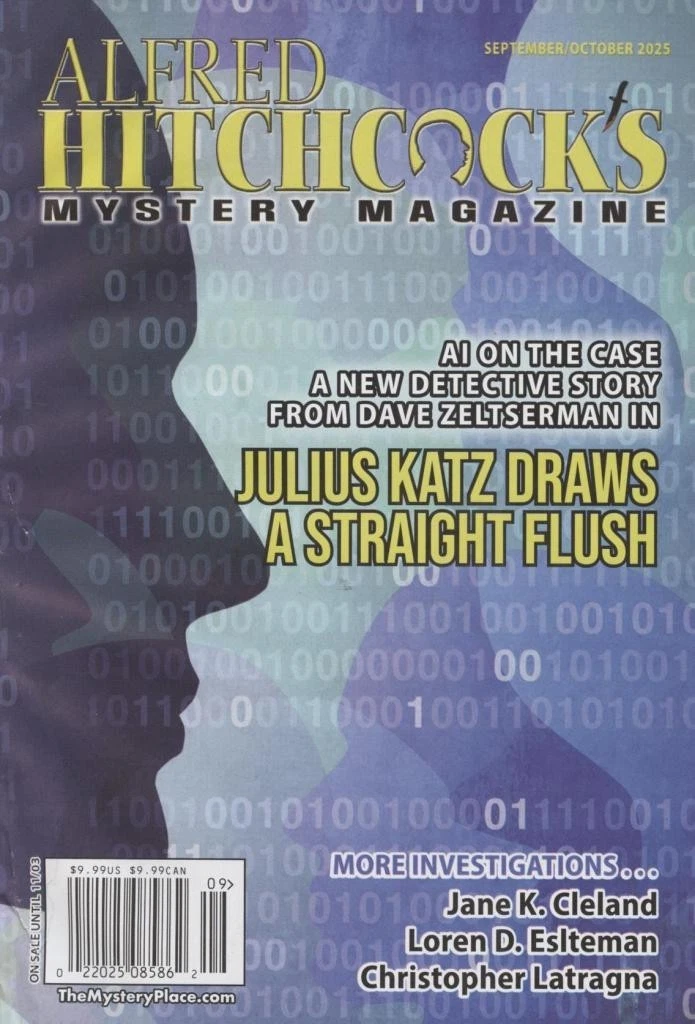
"This Time Oughta Go Different," by Robert Mangeot, in Alfred Hitchcock's Mystery Magazine, September/October 2025.

 This is the sixth appearance in this space by my fellow SleuthSayer.

Mangeot's stories are mostly about character and language.  For example, glom onto this opening paragraph. 

In need of his five o'clock Tanqueray and tonic, a dire need after an all-day mandatory ethics seminar, Vernon took his chances at the Hotel DeLuxa.  Nashville had gone hotter than hell's boiler room, and the DeLuxa offered the lone walkable glimmer of refinement in this South of Broadway wasteland.  A glimmer only.  The DeLuxa was sterile and grayed over, with not one velour cushion to ease Vernon's trick back moaning from the seminar's unforgiving stackable chair.  He'd been non-chargable all week, sidelined, and without much glimmer there on that turning around, either. 

 From this we know the location, the season, the tone, and mostly we know that our protagonist is an ethically-challenged lawyer  down on his luck.   

But wait! The bartender has a mild pain which Vernon is convinced can be stretched into a profitable workman's comp case.  The only problems are that the hotel seems to be mobbed up, the bartender isn't interested in suing, and, uh, she has disappeared.   

Okay, those issues might worry a lesser man than Vernon.  Or a less desperate one. 

Very funny story. 

Sunday, November 2, 2025

Murder in F Sharp, by Stephen Ross


"Murder in F Sharp," by Stephen Ross, in Alfred Hitchcock's Mystery Magazine, September/October 2025.

This is the fourth appearance here for my fellow SleuthSayer Stephen Ross. 

There are plenty of cliche plots, or if you prefer tropes, that show up in mystery short stories.  I think I read two or three stories a year about a child - usually a boy - discovering a dead body and deciding to investigate.

That's how we start here but as always the question is what you do with the material. Ross uses it in highly original ways.

My name is Thomas Phipps, and I discovered a dead body today.

Thomas is sixteen and he doesn't have to investigate the murder because he has a strong suspicion about who did it.  And anyway, he has a bigger problem: his father wants him to keep taking classical piano lessons but Thomas wants to learn jazz.  Now that's an important issue.

As I have said before, sometimes I read the first sentence of a story and find myself hoping the author can keep up that quality to the end and be my best-of-the-week.  But this story belongs to the other extreme: I didn't know it was my Best until the next morning when I woke up, still thinking about it.  Fine work.


Monday, August 18, 2025

Penalty for Early Withdrawal, by Michael Bracken


 "Penalty for Early Withdrawal," by Michael Bracken, in Alfred Hitchcock's Mystery Magazine, July/August 2025

This is the eleventh appearance in this column by my friend and fellow SleuthSayer.

I have said before: Noir is the American Dream in a funhouse mirror. An unimportant person tries to Make It Big, but they do it through crime.  Things generally don't end well.  (The Great Gatsby is absolutely noir.)

It's 1957 and Jolene Carver is one of the thousands of young women who go to Hollywood to Make It Big in the movies.  When the story opens she is in a bank to close her account which will allow her to cover the rent for another week.  "Then she would have to decide if she would entertain men for money the way her friend Martha did or use the two-shot derringer in her purse to put an end to her dreams."

But fate throws another option into the mix when a man named Buck -- yet another would-be actor -- robs the bank.  Jolene finds a different use for her little purse gun.

I won't tell you the rest of the journey except to say our protagonist thinks fast and decisively.  But that doesn't mean your decisions are always wise and not every movie has a happy ending. 


Saturday, August 9, 2025

The Violent Season, by Jessica Van Dessel


 "The Violent Season," by Jessica Van Dessel, in Alfred Hitchcock's Mystery Magazine, July/August 2025

Helen wants a divorce.  Ed is reluctantly willing to go along, so she has "the look of defiant guilt that is displayed by people who are about to get their own way."  (Ooh, that's good.) 

Problem is it is 1956 and in New York the only grounds for divorce are desertion or adultery.  Ed is willing to provide the latter.  Well, he doesn't actually want to commit adultery but he has contacts who will put him in touch with a woman willing to pretend in front of a camera.

Pretty messy stuff but it gets worse when somebody ends up murdered.  And just when Ed thinks he has that problem solved, along comes...

Every time you think you have a handle on this story it shifts in a new direction.   I enjoyed it a lot.

Sunday, March 23, 2025

Come Forth and Be Glad in the Sun, by Mat Coward

"Come Forth and Be Glad in the Sun," by Mat Coward, in Alfred Hitchcock's Mystery Magazine, March/April 2025. 

This is the tenth story I have reviewed by Mat Coward and, good grief, the second this month.

What should the opening sentence of a short story do?  The only thing it must do is make you want to read the second sentence.

But it can do so much more.  For instance: 

* It can set the mood.

* It can tell you something about the plot.

* It can introduce one or more characters.

Now try out this for an opening gambit:

"Of all the people we have ever kidnapped, you are by far the rudest."

* Mood: Farce.

* Plot: Kidnapping.

* Character: At least two serial kidnappers, one of them grumpy.  At least one victim, apparently rude.

Did it make you want to keep reading?  It sure did for me.

Gemma and Nathan, sister and brother, are the victims.  They refer to their captors as Nice and Snitty Nappers. (Snitty, of course, is the one who complains about their manners.) We learn a lot about their personalities.  Nathan is the genius who never found anything to do with his life. Gemma is the grouchy businesswoman who runs an escape room business.

And as for the Nappers, they explain that they are "permanent security consultants" but their boss is getting old and it "had been ages since they'd last been required to consult anyone concerning their security and their baseball bats and steel-capped boots were growing old with neglect." 

This is a delightful tale with some wild plot turns.


Sunday, February 23, 2025

The Eyes That Won't Die, by Michael Mallory


"The Eyes That Won't Die," by Michael Mallory, in Alfred Hitchcock's Mystery Magazine, January/February 2025.

This is the seventh appearance in this space by my friend and fellow SleuthSayer Michael Mallory.

The title reads like horror, but the story reads like classic Black Mask.

It's 1946 and Jim Beckley survived the war but, like many of his comrades, he is having trouble with the peace.  He is living with his wife (who he only met three months before they married) in a hastily built Quonset hut village for ex-GIs and their families.  Memories of people he killed are haunting him and no one seems to understand.  Jobs are hard to find and so, for Jim, is the gumption to hunt for one. 

When the ex-GI living in the other half of his barrack is murdered and dumped in the street, Jim is  suspected of the murder.  If you know this sort of story you know that he is going to wind up investigating the killing, and so he does.

I am a sucker for stories in which the protagonist has  chance at redemption.  This is a good one.