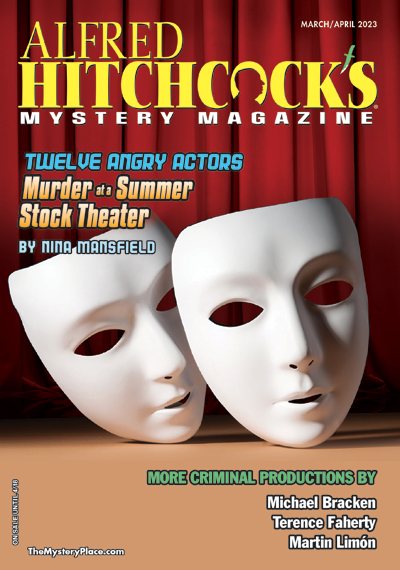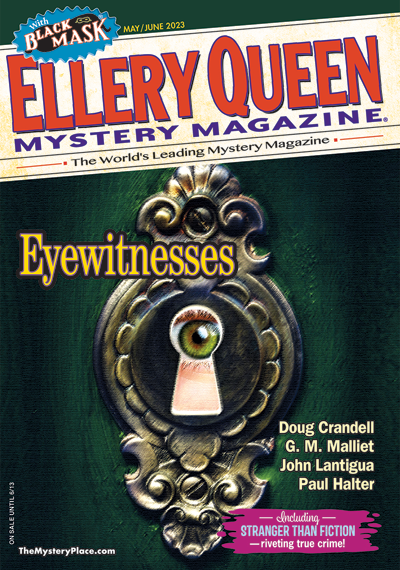
"The Mayan Rite," by Terence Faherty, in Alfred Hitchcock's Mystery Magazine, June 2013.
"When I first heard 'Mayan rite,' I thought it might involve a human sacrifice. Maybe even the removal of a beating heart."
Anya's smile died. "Every wedding requires a human sacrifice," she said. "And often the removal of a beating heart."
Well, I don't know about you, but that exchange certainly got my attention. It happens deep in the middle of this story, which is largely a character study. My co-blogger Faherty has a great talent for characterization through dialog. See Anya above, for instance.
The protagonist, Robert, is a middle-aged guy, down in Mexico for a family wedding. We don't learn a lot about him (not coincidentally he's the one who talks the least, a very reserved sort of guy). His brother, on the other hand, is more outgoing: "Before we're done, Mexico's gonna be sending out for more tequila!"
But Robert is the one who notices what appears to be an unhappily married couple. And he notices some bad stuff... There is clever deduction in here too. A lovely piece of work.
Showing posts with label faherty. Show all posts
Sunday, April 21, 2013
Sunday, January 27, 2013
Margo and the Silver Cane, by Terence Faherty
"Margo and the Silver Cane," by Terence Faherty, in Alfred Hitchcock's Mystery Magazine, January/February 2013.
Last week I saw All Through The Night, a weird movie with an amazing cast (Bogart, Lorre, Phil Silvers, Jackie Gleason, etc.) that starts out as a pretty good comedy and sort of devolves into the Bowery Boys versus the Nazis. I bring this up because Faherty's plot hits similar territory: a Nazi plot against New York harbor in the days before Pearl Harbor. I like his story better than the movie, though.
Margo Banning is an ambitious career woman, working as associate producer on a Sunday radio show. One of the stars is Philip St, Pierre, a self-proclaimed "radio detective." And in this week's show he announces that next week he will be revealing the identity of a top German spy. What follows is a lot of fun and amusingly written. Take this conversation regarding one of the other performers on the radio show.
"You are not a radio detective?"
"That question takes us into the realm of philosophy. Or do I mean psychology? Are we who we decide to be or who the world tells us to be? For example, I work with a woman who has forced her will upon the world. She's become a former Broadway star despite the inconvenience of never having been a current one."
"Mamie Gallagher," Edelweiss said a little wistfully. "She has a very attractive voice. I imagine her blonde."
"So does she."
The ending clearly hints at more adventures to come. I look forward to them.
Last week I saw All Through The Night, a weird movie with an amazing cast (Bogart, Lorre, Phil Silvers, Jackie Gleason, etc.) that starts out as a pretty good comedy and sort of devolves into the Bowery Boys versus the Nazis. I bring this up because Faherty's plot hits similar territory: a Nazi plot against New York harbor in the days before Pearl Harbor. I like his story better than the movie, though.
Margo Banning is an ambitious career woman, working as associate producer on a Sunday radio show. One of the stars is Philip St, Pierre, a self-proclaimed "radio detective." And in this week's show he announces that next week he will be revealing the identity of a top German spy. What follows is a lot of fun and amusingly written. Take this conversation regarding one of the other performers on the radio show.
"You are not a radio detective?"
"That question takes us into the realm of philosophy. Or do I mean psychology? Are we who we decide to be or who the world tells us to be? For example, I work with a woman who has forced her will upon the world. She's become a former Broadway star despite the inconvenience of never having been a current one."
"Mamie Gallagher," Edelweiss said a little wistfully. "She has a very attractive voice. I imagine her blonde."
"So does she."
The ending clearly hints at more adventures to come. I look forward to them.
Sunday, July 29, 2012
After Cana, by Terence Faherty
"After Cana," by Terence Faherty, in Ellery Queen's Mystery Magazine, September/October, 2012.
"You usually go door-to-door bothering people until one of them knocks you in the head." That is a friend of Owen Keane, explaining his usual style of amateur detective work. In this story his approach is more armchair-ish, if that's a word, but very satisfactory.
Keane is a troubled guy with a murky past, explored in previous Faherty tales, and when the current story opens he is accompanying a friend to the wedding of a couple he doesn't know. The minister's familiar sermon on weddings creating a new community gets him thinking about people in his past, but a few days later the new couple is killed on their honeymoon, and that's what really gets him thinking.
Was it, as it appeared to be, a meaningless mugging death, or is something even more sinister going on? Keane cleverly traces the roots back to an event that happened fifty years ago, and then forward again to the present day. The story is well-written with nice characterization of the minor players, which help Keane reach the final deduction. A nice piece of work.
"You usually go door-to-door bothering people until one of them knocks you in the head." That is a friend of Owen Keane, explaining his usual style of amateur detective work. In this story his approach is more armchair-ish, if that's a word, but very satisfactory.
Keane is a troubled guy with a murky past, explored in previous Faherty tales, and when the current story opens he is accompanying a friend to the wedding of a couple he doesn't know. The minister's familiar sermon on weddings creating a new community gets him thinking about people in his past, but a few days later the new couple is killed on their honeymoon, and that's what really gets him thinking.
Was it, as it appeared to be, a meaningless mugging death, or is something even more sinister going on? Keane cleverly traces the roots back to an event that happened fifty years ago, and then forward again to the present day. The story is well-written with nice characterization of the minor players, which help Keane reach the final deduction. A nice piece of work.
Subscribe to:
Posts (Atom)